
HOW TO RECOGNIZE A BEAUTIFUL MAN'S SHIRT?
Temps de lecture : 3 minutes
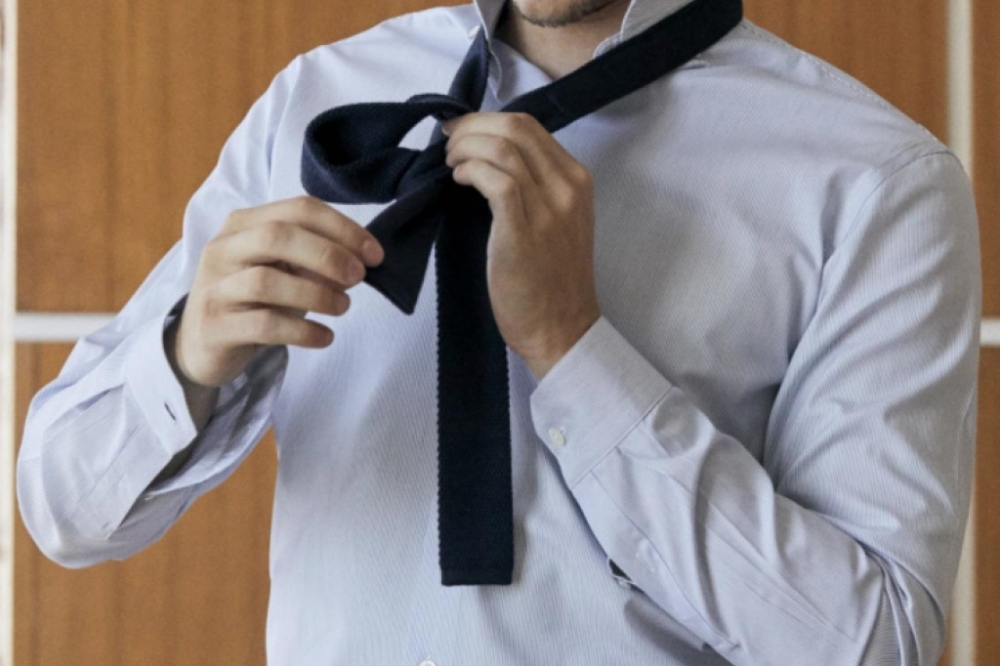
Nowadays, men can't do without a shirt. More elegant and versatile than the T-shirt, it can be worn very seriously but also very casually: depending on its fabric, its outfit and the way it is buttoned up or its sleeves rolled up. Whatever the occasion, it highlights its man. It is however necessary to choose it well, because a shirt that is too big, badly cut or of poor quality is a disservice, both in terms of appearance and durability. Conversely, a quality shirt makes all the difference and is noticeable.
What are the characteristics of a good shirt? What criteria should you use to choose it? We give you all the leads in this article.
The characteristics of a good shirt
There are eight criteria that will make all the difference.
1. The fabric
This is the first criterion to which we pay attention. The quality of the fabric is essential for a beautiful shirt man, as much for the aesthetics as for the comfort throughout the day. Exit synthetic materials, we focus only on natural materials such as cotton, linen, flannel.
To test the quality of the fabric, we take into account two concepts: the quality of the thread used for weaving and the thickness of the fabric.
The quality of the thread or the titration
The titration corresponds to the fineness of the thread. It is inversely proportional: the higher it is, the finer the yarn. We classify the threads from 80 to 200 for the finest. A very fine thread gives a soft fabric but fragile and difficult to maintain. The ideal is to choose a titration around 100. Beyond 140, the fabric becomes too fine, too delicate and crumpled. On the other hand, a low thread count is not always synonymous with poor quality, it is coarser threads used for casual shirts in oxford or flannel for example.
The thickness of the fabric
For a cotton shirt, we choose a double weave: the cotton fibers are woven together to give a long thread, which is itself woven with another identical thread. We speak of the warp thread and weft thread. The result is a quality fabric, resistant, with stable colors over time and softer to the touch.
If it is indicated 100 /2 on the fabric, it means that the titration is 100 and that the thread is double twisted.
Finally, there are different types of weaving of the same plant (cotton, linen ...) which allow us to obtain more or less light materials, which we will not wear for the same occasions.
Poplin: this is the fabric most used for men's shirts. Poplin is woven with a warp thread that is finer than the weft thread. Light, smooth and soft, and very comfortable to wear, poplin is perfect for formal shirts. It is woven from cotton, sometimes wool or silk. It is also very popular for its ease of care and quality.


End-on-end: the end-on-end is close to the poplin, the difference lies in the weft thread whose color differs from that of the warp thread, which gives it relief. The shirts in thread to thread are used a lot in the framework of work also.


Twill is a durable fabric that is soft to the touch and has a certain hold. It is not very wrinkled and is easy to iron. It is woven by shifting the weft and warp threads. The result is a weave that shows diagonal lines. It is a perfect shirt for a formal evening, and also very appreciated in winter for its robustness.


Herringbone: it is a fabric close to the twill. It is differentiated by its alternating diagonals that bring a lot of elegance to the fabric. It is mainly worn as part of a dressy evening.

Oxford: Oxford is a thick, sturdy fabric with a braided weave derived from canvas. Its checkered texture is the result of a weave of two colored warp threads and two white weft threads. It is a non-smooth fabric that has a particular grain to the touch. Oxford shirts are casual shirts, very comfortable to wear, which are reserved for evenings and weekends.

Denim: the strength of denim comes from its tight weave. It is a casual shirt that can also be worn with a tie and a jacket, and in any season. The denim shirt has a patina over time.


Chambray is a light, textured fabric woven with an indigo warp thread and a white or ecru weft thread. Lighter than denim, chambray is worn casually in summer. Or in the fall layered with a tee shirt, cardigan and jacket.


Flannel: to obtain a flannel fabric, the fabric is scraped between two rollers with pins that turn in the opposite direction. The fabric frays, which allows to obtain the softness and the fluffy aspect sought. It is a shirt that is worn in a relaxed way on weekends, and in winter.


After carefully choosing the fabric, we focus on the collar of the shirt.
2. The collar
The collar signs the shirt and gives it all its elegance. It must be impeccable and rigid for a formal shirt. A soft collar is to be avoided at the office or in a social event.
For a casual shirt, the collar may not be as rigid as for a formal shirt, nevertheless it must be maintained and it must be thick enough.
There are several types of collars.
The Italian collar: it is a very open collar, which is worn with thick tie knots. Very modern, it is easily associated with a suit. It is suitable for all body types except for men with a large neckline.

The French collar: it is a classic collar without taking risks. It has a light opening. It is worn with a thin tie, it adapts to all situations, in the office as in social events, but also on more casual shirts. It suits all faces, especially round faces and small necks.

The English collar: it is closed on the front by a placket which gives it a very formal style. Its opening is light. Its placket allows to highlight the tie knot, which will be rather thin. So you can't wear this shirt without a tie. It is a collar that lengthens the face.

The American collar: it can be recognized by the small buttons that attach the points of the collar to the shirt. It is worn casually, often with oxford or flannel shirts. It was created for polo players to prevent the collar from getting in the way when galloping. It can also be worn with a tie for an elegant and relaxed look.

The club collar: it is a rounded collar, very elegant, often white on a colored shirt. It is matched with a tie for a distinguished style.

The wing collar: the wing collar is synonymous with elegance, it is worn at major events, with a bow tie or a lavaliere and a tuxedo.

The officer collar: it is a collar without flaps, which closes with a button. Very modern and rather casual, it is often seen on linen shirts. It comes from the army officers' jackets. It does not allow the wearing of a tie or a bow tie.

The Mao collar: it looks like the officer collar but without buttons. It is worn in summer on linen shirts, it can be casual or more formal depending on the outfit. It lends itself perfectly to a summer cocktail party.

Whatever the collar chosen, it must highlight the head carriage.
The collar of the shirt, whatever it is, must be rigid. Whalebones can be used to allow the collar to stand up straight and keep the points in place. Removable stays are preferred to stays sewn into the collar, which could tear the collar during successive washings. Removable stays can also be changed if they lose their rigidity. The ribs come in different formats: plastic, horn, metal, wood. We prefer whalebones made of natural materials, which are durable over time.
Finally, we choose a sewn collar and not iron-on. Iron-on consists of applying a layer of glue between the different thicknesses of the collar, for a faster and cheaper production. Unfortunately, iron-on collars get damaged faster. As the collar is washed, a series of "blisters" appear on the fabric, indicating that the glue is deteriorating. To know if the collar is ironed or not, you slide the collar fabric between your fingers. If it does not move, it is most likely fused. However, if you feel several layers of fabric moving, it means that it is a sewn collar. That is, the three parts are sewn together.
Nowadays, iron-on collars are of very good quality. If you know of a brand that uses it but whose shirts do not move, you can trust it.
After the collar, the armhole, to ensure comfort throughout the day.
3. The armhole
The armhole corresponds to the seam of the sleeve to the body of the shirt. It allows comfort throughout the day and ensures a certain aesthetic. The armhole must be close enough to the body but also allow it to move, to enjoy a certain ease. An armhole that is too tight will prevent movement, and an armhole that is too wide will have no style. To ensure that the armhole is the right one, choose a shirt whose seam between the sleeve and the body falls right at the natural break of the shoulder.
This seam should be as discreet as possible. The ideal for this is to choose a shirt with an English seam: it has a bead on the back of the shirt and a single thread seam on the front. Avoid double-stitching, which is a less elegant flat seam with two threads.
4. Aligning the patterns
For shirts with stripes, checks or a visible weave, we check if at the level of the shoulder these patterns are perfectly aligned with those of the sleeve.

5. The cuff or wrist
Just like the collar, the shirt cuffs must be rigid and hold. The buttons should be well positioned, the seams regular and discreet. The objective is to obtain a nice roundness around the wrist.
There are three types of cuffs:
The simple cuff: one or two buttons, rounded, square or broken corners
The folded or musketeer cuff: closes with cufflinks
The Neapolitan cuff: a simple cuff with folded sides

The length of the sleeves is also very important, the sleeves should not be too short, nor too long. The ideal length is considered to be when they slightly exceed the sleeve of a suit by 1 to 2 cm, and this when the arm is along the body. In no case should the sleeve cover the hand.
We choose a discreet cuff: simple with one or two buttons or musketeer for special occasions. We also check that they are not thermo-bonded to avoid blisters that appear after several washes.
Finally, the cuff lining must be in the same fabric as the shirt, otherwise it will be a blatant misunderstanding.
6. The buttons
These, as well as the button placket, must be of quality and not fray to last with the shirt, especially since they are very solicited with the successive buttoning and unbuttoning.
There are three types of placket:
American

Hidden

Simple

Avoid the hidden placket, which is neither aesthetic nor elegant, unless it is worn on a casual shirt with a mao collar.
For an elegant shirt, choose a simple placket, which will be hidden by the tie. For a casual shirt, we choose either a simple placket or an American placket that brings a certain style to the shirt.
As for the buttons, we choose them in mother-of-pearl but thick enough to last, or in plastic if not. Mother of pearl buttons require the shirt to be dry cleaned. The thicker they are and the whiter the reflection, the higher the quality of the mother of pearl. There are also plastic buttons of very good quality and more accessible.
For casual shirts, you can opt for wooden or horn buttons.
Finally there are different ways to sew buttons: parallel, cross or houndstooth. The first two are easy to do with a machine, unlike the third. Buttons sewn crosswise or houndstooth are more solid. The important thing is that the seam is thick and that the button is stable.
Parallel, cross sewn and houndstooth

7. The cut
The cut is also very important because it determines the overall look of the shirt.
There are three types of cuts. The slim fit, the fitted fit and the straight fit.
The slim fit: The slim fit sculpts the body in order to highlight the shoulders and a slim waist, in the idea of a V. You can only afford this cut if you are very athletic. Otherwise, it is a cut that serves the owner of the shirt. You have to be careful not to be molded in this shirt, nothing less elegant than buttons that struggle to stay in place.
The fitted cut: This cut offers more comfort but remains close to the body. It enhances the silhouette and build while allowing more movement. It is to be preferred because it enhances the owner's appearance regardless of his or her weight. Especially for formal shirts. It is more comfortable than the slim fit and more elegant than the straight fit. On the other hand, if creases form at the buttons, it is probably too small, so we opt for the top size or, failing that, a straight cut.
The straight cut: It gives even more ease and is not tight at the waist, which gives a certain floating. It is worn casually on the weekend or after work. It was very fashionable in the 80s and 90s.

8. The details
The pocket: Dress shirts do not have pockets. Conversely, casual shirts can have one. There are several types of pockets: the classic pocket, the round pocket, the cut pocket, the diamond pocket and the flap pocket.

The capuchin placket: The capuchin placket is a piece of fabric buttoned on the forearm from the sleeve to the cuff. It allows you to open the sleeve more easily. It is mainly found on casual shirts.

The swallow of reinforcement: The reinforcement swallow is a small piece of fabric discreetly placed at the bottom of the shirt, it brings strength to the shirt by protecting the joint of the sides and avoiding any tear of the shirt.

The collar turn: To ensure that the collar is the right size, you should be able to pass a finger between the collar and the neck, once the collar is closed.
The seams: The seams should be precise, clean and regular, and the fine stitches discreet and close together. The seams follow the curves of the shirt and should form nice curves.
The ideal is to have 5 to 6 stitches per cm, even 7 stitches for a quality shirt that will last over time.
The length: For a formal shirt, the length must be important to be able to fit it in the pants without it being rebickened. On the other hand, for a casual shirt, the length is shorter because it is worn out of the pants: it must arrive just below the belt.
The label: It must be soft and above all not scratchy! We can check that its seam is smooth.
Here is a small summary to keep with you so you don't make a mistake the day you choose a new shirt:
➔The collar: you must be able to pass a finger between the neck and the collar once the collar is closed.
➔The sleeves: they should reach about two cm above the base of the thumb.
➔The shoulders: the seams must be located at the break of the should.
➔The cut: one must be able to move without being embarrassed, sit without being tight and without tension at the level of the buttons, while having a fitted shirt.
➔The length: important for a formal shirt, just below the belt for a casual shirt.

HOW TO CHOOSE THE PERFECT SHIRT
Read more
Published : 02/26/2020 12:12:47
Mao collar and Officer collar, the differences
Read more
Published : 02/17/2020 18:27:55
HOW TO KNOW YOUR MORPHOLOGY ?
Read more
Published : 10/02/2019 11:59:59
COTTON, BACK TO ITS ROOTS
Read more
Published : 03/13/2020 17:23:15
SHIRT COLLAR STAYS: WHEN TO WEAR THEM?
Read more
Published : 04/19/2021 10:36:23
THE DIFFERENT TYPES OF SHIRT FABRICS
Read more
Published : 02/18/2020 11:14:44
THE DIFFERENT SHIRT COLLARS: HOW TO WEAR THEM? FOR WHICH FACE SHAPE?
Read more
Published : 05/31/2021 14:53:17
HOW TO CHOOSE A SHIRT FOR A JOB INTERVIEW ?
Read more
Published : 03/04/2020 16:41:16


