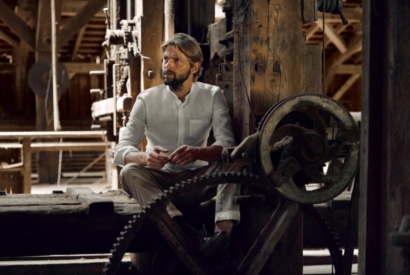
"There is a man in every shirt.”
Johann Wolfgang von Goethe, German writer and scholar
The shirt, or chamisae in the 10th century, from the Latin camisia, was a white cotton or linen garment worn next to the skin. The longer it was, the wealthier its owner was. From the Renaissance, the shirt became a full-fledged garment with a collar. In the XVIIIth century, it was cut in more noble materials such as silk. It represents a real means of social distinction. The notables and intellectuals in white collar are differentiated from the famous blue collars who work in factories. The first mass-produced shirts appeared in the middle of the 19th century.
Today your shirt defines you, it speaks about you, about your personality. It is the key piece of your wardrobe, it accompanies you in all the moments of your life, whether at the office, with friends, on formal or casual occasions.
Its role: to enhance your appearance while providing comfort and ease throughout the day.
Its imperatives: the quality of the materials, a perfect fit, and careful tailoring.
Follow the guide to help you choose the shirt that suits you best and for more information, refer to the most famous men's blog, "Comme un camion" which provides excellent advice on the shirt.
-
Know how to differentiate between fabrics
All day in contact with your skin, the fabric of your shirt must be soft and breathable. This automatically excludes synthetic materials. Instead, we prefer 100% natural and breathable materials such as cotton or linen, opting for a certain weight, weight and twist, guaranteeing the quality of the fabric chosen.
Know that the best qualities come from Egypt and the Caribbean where the climate is the most adapted to obtain fine and resistant fibers.
What is titration ?
The titration corresponds to the fineness of the yarn used thanks to the weight/length ratio. The higher the titre, the finer the yarn, the softer the fabric but the more fragile and difficult to maintain. We classify the titers on a scale of 80 to 200, with an average around 80 to 120 for a shirt. The best balance is around 100. An example of a rating is 60/1 or 80/2 or 90/1. The first number represents the count and the second number corresponds to a double-twisted or single-twisted cotton.
Twisting is the process of twisting several yarns together to form a single yarn.
A single-twisted yarn is made with spun cotton to obtain a single yarn.
Conversely, a double-twisted cotton is made by weaving a double warp thread with a double weft thread. The thread is wound on itself to strengthen itself by binding its fibers to each other. The result is a fabric that is silkier and more robust than a fabric made from a single twisted thread, more comfortable to wear and easier to iron. Its colors are also more beautiful and more stable over time. So choose a weave with a double-twisted yarn.

What is the weight ?
The weight of a shirt indicates the weight of the fabric used. It is measured in g/m2 or in g/ml (linear meter). The linear meter represents one meter of fabric over a variable width (depending on the roll of fabric). This width is called the width, it can be 1m10, 1m20, 1m40 ... The more the weight of the fabric is important, the heavier the fabric will be. Thus for a summer shirt, we will choose a lightweight, unlike a shirt designed for winter.
For example, a summer shirt will have a weight less than or equal to 80g/m2. A mid-season shirt will be between 80 and 150g/m2. A winter shirt will have a grammage higher than 150 g/m2. These figures are given as an indication but the most important is your feeling and the fact that you feel good in your shirt!
The different weaves
Then choose a fabric that corresponds to your needs, is it a shirt to be worn at the office? for a party? for a special occasion like a wedding? in summer? in winter? The weave will vary greatly from one option to another. Here's a list to help you figure it out:
Poplin
Lightweight, easy to iron, poplin will be perfect to accompany you in your professional life. You will recognize its quality by its silkiness: the softer it is, the better it is.

The end-on-end
It is similar to poplin but requires at least two colors of yarn in its weave to create a textured fabric, very elegant to wear. It is suitable for all seasons, and lends itself perfectly to a formal environment such as a chic evening.

The twill
Twill is made from a weaving process that shifts the weft and warp threads. It is recognizable by its bias stripes. It is a dense, low-crease fabric that is perfect for formal occasions. Resistant, it is ideal in winter.

Oxford
Woven from two colored warp threads with two white weft threads, oxford is a thick, sturdy, low-crease fabric with a slightly two-tone look. Oxford shirts are best suited for casual occasions, such as parties and weekends. But they can also be paired with suits for a smart-casual look, if the weave and pattern are not too obvious.

Denim
Now a must-have in the men's wardrobe, the denim shirt can be worn either in a very thick weight as an overshirt over a tee-shirt for a relaxed spirit, or in a very thin weight and a really plain color under a jacket, with jeans and leather shoes for a sophisticated look. It is a shirt that can be worn in all seasons thanks to its very tight weave. Its color fades with each wash.

Chambray and linen
Two materials that are similar, for the same purpose: the ultimate summer shirt, breathable, textured and light, which accompanies you during your evenings with friends, elegant or casual.
The Chambray

Linen

The flannel
The winter shirt with the fluffy look, soft and warm that you will never leave once you discover it. Available in solid colors and tartan patterns, it can easily be paired with jeans or a neutral chino.

Tip: to help you determine the quality level of a fabric, go to high-end boutiques and touch each material, you will gradually become familiar with the hand of a high-end fabric.
-
Choosing the right shirt cut for your body type
There are three major cuts:

The slim fit
It is designed for slim and sporty morphologies. With its V-cut, it emphasizes the shoulders and the body. Be careful not to choose a shirt that is too tight though, as you may feel cramped and uncomfortable. The shirt should not wrinkle or show signs of tension when buttoned.

The fitted cut
Similar to the slim fit, it is nevertheless a little looser and therefore more comfortable to wear. It leaves you freer in your movements while emphasizing your body. It highlights all morphologies.

The straight cut
Very fashionable in the 80s, it is less worn today. It is nevertheless adapted to a very streetwear style or fits perfectly as an overshirt on a tee-shirt.

-
How to recognize a beautiful shirt
Often the quality of the fabric and the beautiful cut rhyme with the finishing touches.
Here are the details to look at to be sure.
The seams
You can be demanding, they must be impeccable: precise, discreet and regular. They must follow the edges of the shirt in a nice parallel, whether it is the collar or the side of the shirt. The stitches must be fine and close together with an ideal of 7 stitches per cm. The more dense the stitches, the longer the seam will last, and the more the shirt will look neat and solid.
The collar
It gives all its personality and elegance to a shirt, and influences your silhouette. It must be rigid, thick and impeccable especially for a formal outfit. No more soft collars! Some shirts have ribs that give their collars their rigidity, these can be removed during washing, which increases the life of the shirt.
The choice is wide, here are some major examples. Each of them will be better adapted to a particular occasion and to certain morphologies.
-
The French collar
This is the classic and timeless collar par excellence. It can be worn with or without a tie. Its opening is light with close points. It is adapted to all morphologies but more particularly to round and square faces to which it gives length.
-
The Italian collar
This is the second most common collar. It has a wider opening than the French collar, so it can be worn with a wide tie or without a tie. Its style is classic and elegant. It is not suitable for strong necks. On the contrary, it highlights long and thin necks.
The English collar is distinguished by a small opening and a tab under the main button, which connects the two sides of the collar. This allows to highlight the tie knot, so you can not wear this shirt without a tie. This collar lengthens the face.
-
The American collar
The American collar or button-down collar is folded over the shirt with two small buttons. At the time, this prevented the collar from rising on the face for polo players. It can be worn without a tie, and is more suitable for a relaxed occasion. It particularly highlights round and square faces.
The club collar, very elegant, often white on a plain blue or striped shirt, is worn on special occasions such as a wedding or a cocktail party.
-
The officer collars and mao collars
They look alike, they bring an exotic and modern side to a formal outfit. They are obviously worn without a tie, and are suitable for all faces.

Armholes
They are very important because they guarantee the comfort of the shirt. They should not be too tight or too big. In addition, the shoulder seam should be just at the height of your shoulder. The sleeve starts just at the natural break of your shoulder, and its width must allow you to remain free in your movements.

The cuffs
Like the collar, the cuffs can vary a lot from one shirt to another. A cuff with two buttons will be more elegant than a single button. A musketeer cuff that closes with cufflinks will be suitable for a particularly distinguished occasion. The rigidity of the cuffs and the discretion and regularity of their seams will not be overlooked. The objective is to have a nice roundness around the wrist.

The buttons
The top of the range remains the mother of pearl. The thicker the mother of pearl button, the more resistant and of good quality it is. It has elegant reflections and enhances the formal shirt. There are also buttons in many other materials such as plastic, wood, resin, more suitable for casual shirts. Buttons can be cross-stitched or crow's foot, they will be more solid than those with parallel seams. They have an important role because they bring an additional touch in the personality of the shirt.

Pockets
Pockets are more often found on casual shirts. They have a functional role but also play in the style of the shirt. Their corners can be rounded or pointed, they have a flap or not.
Here are the different types of pockets you can find:

-
Choosing a shirt in your size
Here are several small indicators that will allow you not to make a mistake:
- the armhole seam should be at the top of your shoulder
- the sleeves should be about two to three centimeters above the beginning of your thumb, once the cuffs are unbuttoned, it allows you to have a shirt that exceeds the sleeve of the suit by about 1 cm, which is very elegant
- you can raise your arms without being embarrassed, but without excess of fabric either
- you are comfortable sitting: not too many folds or excess of fabric
- the formal shirt must have a certain length to be able to be tucked into your pants, unlike the casual shirt that will be worn outside your pants
- you must be able to put two fingers between your neck and the collar of the shirt
Once all these elements are explained, the important thing for you is your general impression: do you feel good in the shirt you have chosen? Is it adapted to your morphology? Do you like the fabric? Are the details and finishing of quality? (buttons, seams, stiffness of the collar and cuffs...) is the fall impeccable?
The ideal shirt should make you look good while being comfortable and last over time. The three key words to remember: elegance, ease and quality.