
LINEN, THE FABRIC OF SUMMER PAR EXCELLENCE
Temps de lecture : 3 minutes
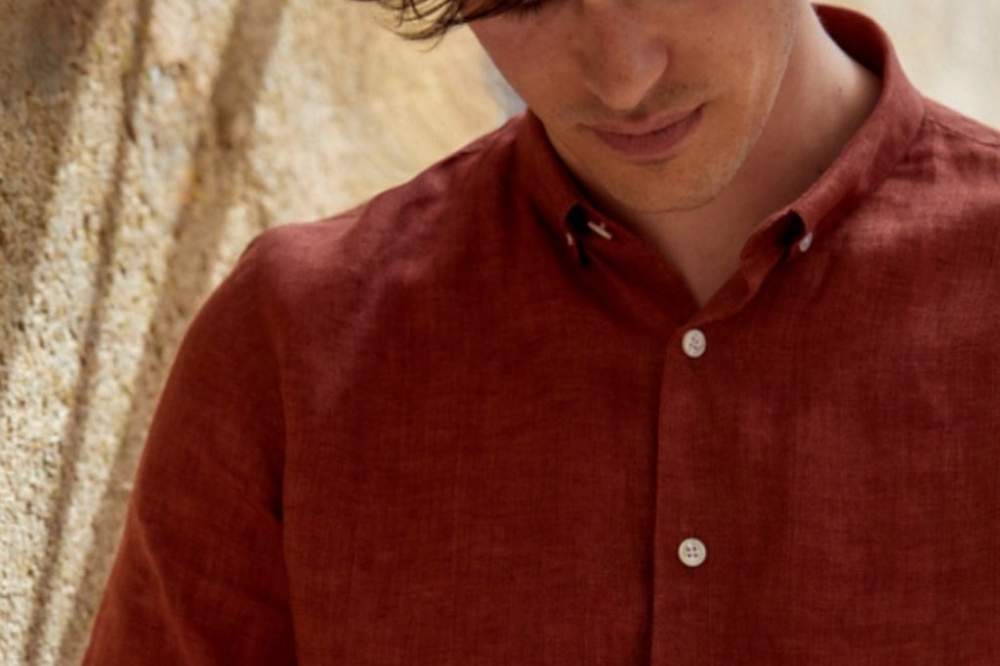
The linen shirt is light, resistant and thermoregulating. Very pleasant to wear, it adapts perfectly to summer temperatures.
What is the history of linen? How is it cultivated and by whom? What are its advantages and disadvantages?
Zoom on this plant with many beneficial properties.
The history of flax
Flax is one of the oldest known textile fibers. Its first traces were discovered in Georgia and date back more than 36,000 years. At that time, linen was used to make ropes or threads for sewing clothes and shoes made of skin. With time, its exploitation spreads in Asia, to reach Egypt and finally Europe.
In Egypt, linen is used in the manufacture of sails and ropes for boats as well as strips for mummification. The Egyptians call it "woven moonlight" and attribute it to the goddess Isis.
In France, linen was cultivated under the influence of Charlemagne in the 7th century. He ordered that linen be spun at court. In the 17th century, Louis XIV wore linen shirts under his clothes. It is at this time that the words "linen" and "lingerie" appear. In 1817, a patent was filed by Philippe de Girard for the first linen spinning machine. Unfortunately, linen was competing with cotton and synthetic textiles which were less expensive to produce.
Flax reappeared in Normandy between the two world wars. It is cultivated by Belgian nationals who took refuge during the First World War.
Flax: the plant
There are no less than 200 species of flax, most of which are wild plants that do not have the quality properties of French flax. The farmers use seeds controlled and certified by the Ministry of Agriculture. They sow the seeds in March. It takes about 100 days for the plant to reach maturity. It is then pulled out with specialized machines, and the stems are placed on the ground. They are left for several weeks to allow them to reach a satisfactory retting.
The flax flower is blue or white depending on the species. It has five petals and lives only a short time.

The retting

The fibers are then extracted from the wood in the stem using the mechanical scutching method. The wood is recycled into bedding or chips.

The resulting fibers are combed and stretched into a huge sliver that will be sent to a spinning mill to be spun and woven.


Until the 1980s, these steps were carried out in Europe, then mostly in China to return as a finished product. Today we are witnessing a reappearance of French spinning mills, which allows us to obtain a 100% French finished product.
Flax production in the world
Flax is grown all over the world: in China, Russia, Poland, Lithuania, Ukraine, France, Belgium, Netherlands, Ireland or Egypt. Nevertheless, the flax fibers differ from place to place. France produces a flax in greater quantity and quality than China, which has a larger area under cultivation.
Western Europe has the most suitable climate and soil for a high quality, fine and resistant flax.
Flax in France
France is the most important producer of flax in Europe due to its temperate and oceanic climate, the quality of its rich and fertile soils and the organizational structure in place. It represents more than 80% of the European production with 77 000 ha cultivated of which 65 000 ha in Normandy. The other regions producing flax are Hauts de France, Picardy and Brittany. Flax in France prides itself on being of the highest quality.
The flax industry in France has two establishments that create flax varieties, seven other seed producers, 27 cooperatives for scutching flax and 6,500 producers also called flax growers.
The industry is governed in France by the European Confederation of Flax and Hemp (CELC) founded in 1951. It federates all the actors: farmers and flax processing companies, which represents more than 10 000 companies.
Irish flax
The cultivation of flax in Ireland dates back to the time of the Phoenicians. From the 17th century, the industry was driven by two Englishmen, Lord Thomas Wentworth, Earl of Strafford and James Butler, Duke of Ormonde. But it was really Louis Cromelin, a Frenchman, who helped modernize the manufacturing process. So much so that in the 18th century, the city of Belfast became the most important linen producer in the world.
Today, the yarns are bought, mostly in China, and then woven in Ireland by one of the members of the Irish Linen Guild, in order to guarantee the Irish linen label.
These few member companies are :
William Clark
Magee (probably the best known)
Emblem
John England
Spence Bryson Linen
Thomas Ferguson Irish Linen
Samuel Upstream
Baird McNutt
Italy
Linen is also woven in Italy, which has many spinning mills. Each of them excels in its own unique weaving. These companies are known as the best textile producers in the world:
Reda
Vitale Barberis Canonico
Loro Piana
Ermenegildo Zegna
Ormezzano, Guabello
Drago
Lanificio Carlo Barbera
Linen today
Today, 90% of European linen is used for the textile market, 60% for clothing, 15% for household linen and 15% for lifestyle. The remaining 10% is dedicated to technical outlets for "high environmental performance" products: stationery, automotive, insulation thanks to its absorbent and resistant properties, health, aeronautics, sports equipment ....
In the textile industry, we are currently witnessing a spectacular revival. Between 2002 and 2007, the area under cultivation rose from 30,000 to 75,000 hectares.
The qualities and disadvantages of flax
Flax is a sustainable plant, which has many environmental qualities.
Its culture is fast, one hundred days are enough. Its fiber requires little watering and very few phytosanitary products thanks to its insect and micro-organism resistant bark. Finally, all its components can be used in today's industry.
Linen is also a light material, both antibacterial and hypoallergenic. It is a very resistant and solid fabric in time thanks to the length and the structure of its fibers, which are several tens of centimeters in comparison with the fibers of the other fabrics (several tens of millimeters). Finally, linen has thermoregulatory properties thanks to its absorbent power: it has pectins which are loaded or released with water according to the climatic conditions. Its absorption capacity can reach 30% of the textile mass while keeping a dry effect. It is a fabric that dries very quickly and evacuates perspiration without leaving traces unlike other synthetic fabrics.
Linen shirts are therefore very pleasant to wear in all seasons. The skin does not need to sweat to refresh itself.
Finally, it is a garment made of natural fabric, which gives it a shine, a hold and a quality superior to synthetic fabrics.
Its disadvantages: linen wrinkles quite easily, more quickly than cotton. It is also rough when first used, but softens quickly with repeated washing.
Linen has many advantages, it is a fresh, light fabric, very pleasant to wear thanks to its thermoregulatory qualities. It is perfectly suited to the summer seasons, especially during the hot weather: it brings comfort and elegance in all circumstances.

https://www.premieremanche.com/en/shirts/170-beige-linen-casual-shirt.html

https://www.premieremanche.com/en/shirts/172-kaki-linen-shirt.html

The linen shirt or summer essentials
Read more
Published : 03/17/2020 14:41:54


